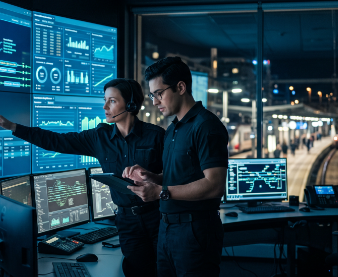

A railway depends on continuous operations, which means it also depends on continuous security. That is the role of the Security Operations Centre (SOC): monitoring threats around the clock, detecting suspicious activity and responding before incidents can disrupt operations. As rail networks become more connected and threats more complex, the SOC has become one of the most important parts of a railway’s cyber resilience. It is also where AI can make the biggest difference.
A railway never closes, so neither can its watch
A railway is never truly at rest. Even when the last passenger trains have stopped, the digital layer keeps running. During quieter hours, maintenance, updates and system changes may still be taking place, while fewer operational teams are active. An intrusion that goes undetected overnight can have hours to spread before the morning peak begins.
The priorities are also different from most industries. In rail, cybersecurity is not only about protecting information. It is also about safeguarding availability and continuity: keeping essential services running. That shifts the priority from protecting information alone to protecting availability: keeping services running. A rail SOC is therefore focused on detecting and containing threats before they can affect operations, rather than investigating them after the damage has been done.
One team watching IT and OT
For a rail SOC to be effective, it needs visibility across both IT and OT. The boundary between corporate IT and operational technology is a particularly critical risk area. A compromise in one environment can create a route into the other. By providing visibility across both environments, an SOC helps detect and contain threats before they can cross that boundary.
That end-to-end view is rare in a railway, but increasingly essential. NIS2 raises the stakes even further. With just 24 hours to report a serious incident, continuous monitoring is no longer just good practice. It is what makes timely detection, investigation and reporting possible. Without that visibility, an organisation may not even realise it has been compromised until it is too late.
Where the SOC reaches its limits and AI helps
An SOC is only as effective as the people behind it and their time is limited. Every day, security teams are flooded with thousands of alerts, most of which turn out to be false positives or low-priority events. Sorting through that volume takes time and attention. The more time analysts spend filtering noise, the greater the risk that a genuine threat is missed or detected too late. This is where AI adds real value. It excels at the repetitive tasks that consume so much of an analyst’s day:
- Triage, prioritising the alerts that require immediate attention.
- Correlation, linking signals from different tools into a single incident.
- Context, bringing together the information an analyst would otherwise have to collect manually.
The result is not fewer analysts, but more effective ones.
Why the final call stays human
AI has an important role to play in a modern SOC, but there is a clear limit to what it should do. It can identify patterns, prioritise alerts and provide recommendations. Decisions that could affect railway operations, however, still require human judgement.
The reason is straightforward. An automated response that isolates a system or blocks access could itself disrupt operations. Deciding whether to act immediately, investigate further or accept a temporary risk depends on operational context that AI cannot fully assess.
Atos runs Security Operations Centres that watch over railway environments across both IT and OT, combining round-the-clock monitoring with AI that takes on the repetitive work, so analysts can focus on the decisions that matter and threats are contained before they reach the trains. As a European partner with deep experience in critical rail environments, Atos delivers these security operations from within Europe, under European jurisdiction.